Thursday, October 22, 2009

Thoughts on Adventure


I feel newly inspired. And perhaps I shouldn't share the idea just yet. But no matter, it all comes out soon anyway. Adventure. What is it? Who goes on adventures? Summing it up: aren't all stories about some sort of adventure? Perhaps not every person carries a whip or beats up villains, but it seems to me that an adventure is about achieving a goal; overcoming obstacles. For Indiana Jones, its the typical beat up the bad guys and save the day--like a medieval knight. Superman, Batman, Spongebob Squarepants, parents, professors, so on and so forth. Homer's epics are large stories of adventure but there are other, smaller stories that make the large one's possible. Due to a recent close to home happening, I recall a certain poem I wrote for a poetry class a year ago entitled "The Battle at Marathon". The poem regards a certain male entity who endures a near death experience in order to reach the ultimate goal. Fertility. And it's a small point, but I've been thinking about it. Doesn't the male reproductive DNA go on it's own journey to create larger journeys for everyone. It has to survive, much like Odysseus, who sails the seas running into foreign lands, barely escaping with his life. So, short, simple and sweet, this is an interesting idea I'm playing with for my next short story. An interview... something to ponder, TBA in story form.

Thursday, October 15, 2009

Thoughts on Great Ideas


I think I was five when Disney's The Little Mermaid came to theaters everywhere. And I fell in love with the main character, Ariel. Because I thought I was her. No matter that I couldn't swim and that I was terrified of water. She was cool because she had red hair like me and could sing just like I imagined I sang at Bible School. I so loved that movie. And when The Lion King came out, I watched the movie with my mom and brother . . . and loved it because Jonathan Taylor Thomas did the voiceover work for Simba. (JTT was sooooo hot!) And even though Moufasa dies in the picture, it's Disney, and hey, what kid doesn't like Disney?

So as I continue in my reading of Homer's Odyssey, I start getting a funny feeling . . . like I've heard some of the stories in this epic before. Oh yes . . . that's because I have. Famous lines and ideas begin to bombard me as I see they've only been reused in the tales I grew up with. For instance, I initially believed George Lucas to be a total genius when I thrived on watching over and over, the original Star Wars trilogy. "Luke, I am your father . . ." -- okay, this has to be one of the most famous lines in movie history. George Lucas, you plot twister, you. But no, I'm adventuring away with Odysseus and I come to a familiar line . . . Odysseus decides to reveal his true identity to his son, Telemachus and says, "Why confuse me with one who never dies? No, I am your father--" George Lucas, I must say, you are much like Will Smith. You take a great work by a great artist and alter it to be your own. Good job. But it's not just Lucas who does this. It is everywhere. For instance, let's take a look at Snow White and the Seven Dwarfs. Okay. A very similar theme takes place in The Odyssey. Athena. When she wants to disguise Odysseus, she simply changes him into an old, scary looking beggar. This scene is much like the Queen in Snow White. In order to "deceive" those around her, namely Snow White, she changes herself into an old beggarly woman, dressed in rags. Athena does the same with Odysseus. He goes from riches to rags and back. . . .again and again. Okay, now let's try The Little Mermaid. The sea witch, Ursula, in order to gain power over King Triton (a mixed up mythological image) uses her "cunning" to entrap Ariel. She tells her she will turn the mermaid into a human where she can be with her prince if Ariel gives the sea witch her voice. And Ariel gives it freely. The sea witch uses Ariel's voice to entrap Prince Eric and keep him from marrying Ariel. Ursula, becoming beautiful, in this sense, turns into The Odyssey's siren. She's irresistably beautiful and her singing voice is not to be turned down. And then there's The Lion King; the most obvious connection. When Odysseus leaves Ithaca, suitors from all over take over his home and eat his house out of food, destroying everything. When the Disney version remakes this story, the King dies. However, the hyenas take over the kingdom, destroying the land around them and eating everything they can find.

When Will Smith would steal tunes from Stevie Wonder and other artists, I was upset, thinking his work was unoriginal and I found it appauling. How could someone steal someone else's work? But as I continue, I see it's done everywhere. Animal Ant Farm redid Michael Jackson's Smooth Criminal, etc., etc., etc. And it seems that everytime someone "borrows" an idea, it's still popular beyond belief. And I love all these Disney movies. And I love Star Wars. . . and it feels a tad odd--I don't want to support things that I feel are stolen but on the same hand, it seems that "borrowing" sometimes builds to bigger and better avenues or avenues that connect with the modern world. And as I'm discovering, it's not all bad to take a great idea and build on it, making more great ideas.

Thursday, October 8, 2009

Thoughts on the Odyssey


Just thinking here . . . why is it that I've fallen head over heels in love with Homer's Iliad but I'm struggling to fall in love with the Odyssey? It's not that the story is uninteresting . . . The Odyssey tends to be the story children fall in love with. Odysseus goes on crazy adventures, running into the Cyclops, Polyphemus, his men are turned into pigs and he takes on challenges by the gods. And these were the stories I loved in the ninth grade when Mr. Berger told us all to pull out our English books and begin reading. We read at home and sometimes we read aloud in class. (Of course, I read the name "Nobody" as "Nobdy" . . . but, oh well). And I fell in love. However, today, it seems the other way around. Totally intimidated by the Iliad, I several times took on the task of reading this monster only to make it through book one (if I was persistent enough to even make it through that) And the Iliad was filled with blood pulp and other types of gore. Am I just that sick these days? I'm not for sure. However, in my quest to discover the meaning of "truth", I think I've discovered the reality in the Iliad. People can be very cruel. And although Homer's Iliad is fictional, the grotesque brutality of human nature is very real--it is a story about men backed into corners; men threatened. And although Odysseus is certainly threatened in the Odyssey, I do not see him as being threatened the same way as the characters in the Iliad. Not even Odysseus himself is threatened the same way in the Odyssey as he is in the Iliad. True, his life is threatened, but he puts himself there. It is as though he had such great success in Troy that his head has only grown bigger in the sequel. Much like many ball players I've known in my time, Odysseus is frankly, a cocky s.o.b. He overly believes in himself thinking himself almost invinsible. And perhaps that is why the story doesn't strike me as much. Not because the story isn't good. I still love the adventures Odysseus goes on, but he is nevertheless that cocky basketball player I knew in high school. Both stories are true to human nature no matter what magic the gods possess. And Odysseus' truth is, he's full of himself, making me understand why he's gone from Ithaca for 20 years. But Odysseus, I'm only your cheerleader in the Iliad; I don't mind that your cocky ass has trouble making it home.

Tuesday, September 29, 2009

Thoughts on Numbers


These past two weeks I have begun to make the transition over from Homer's Iliad to the Odyssey. Wonderful works to be read. But as I'm transitioning, I begin to wonder if both works were really told by the same storyteller. Straight away, the Iliad teems with strong emotions...mostly rage as everyone does kill one another. But The Odyssey begins very calm and serene-like. And as I'm reading, I feel as though I'm on a cruise ship -- enjoying the meals, enjoying the entertainment; enjoying the ride. And then something strikes me. Numbers. They're all the same. Patroclus charged the wall three times. Odysseus was stuck on Calypso's island for seven years. The Trojans fought for nine years... Aside from the 40, 50, 90 long black ships, it seems to me that all the numbers in both texts are 3, 7, or 9. Why? Honestly, I have no idea. The number three is interesting because the Christian churches, I believe, use this number the most. The Holy Trinity. Three days and Jesus rose again. Etc. Outside of the church it seems that everything comes in threes for whatever reason. Take this summer for instance. Michael Jackson and Farrah Fawcett died on the same day. But low and behold, just a few days later, Billy Mays bought the farm. All three big events lighting up the news and our television sets -- three being the prominent number. Perhaps Homer and the Greeks figured this out? Perhaps they recognized that for whatever reason, things (whatever they may be) come in threes. Seven. Okay, seven. Well, there's seven days in a week. That's easy enough. Biblically, seven days to create the universe. Seven is also used a lot in the book of Revelations. Perhaps that was really another thing the Greeks figured out before the Christians harbored it...? I don't know. I'm just told that the number seven represents completeness, which would make sense for Odysseus, seeing how he spends seven years on Ogygia with Calypso before he is released to return back to Ithaca. But why nine? And nine is the real reason this particular blog was spawned. While daydreaming one day, it occured to me, The Trojans fought for nine years before ending the war in the tenth. Okay. It takes Odysseus nine years before coming home in the tenth. (Making it all twenty years for the big guy.) But why nine? It's mentioned a healthy number of times (althought not as many as three or seven). What about the parallel to birth? When a woman conceives, the doctor gives her a due date -- nine months after conception. NINE. And it's funny...people typically believe a woman to be pregnant for nine months when in actuality she gives birth nine months after conception, equaling a grand total of TEN. Perhaps in both texts nine is a significant number because of what ten represents. It is a full circle. An even number. All of our fingers and toes are accounted for. Ten. After nine comes the birth. For the Greeks, it was to win over the Trojans. For Odysseus, it will be his respawning into his native land of Ithaca. As for me, it will take about three months to read The Iliad, The Odyssey, and The Aeneid. Perhaps there is a little something in numbers...

Thursday, September 17, 2009

Thoughts on Fortune and Glory


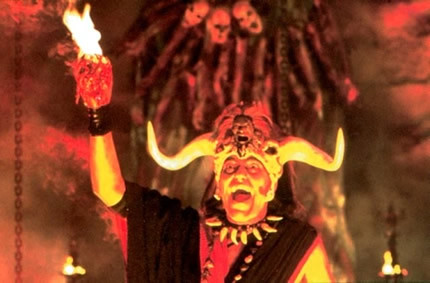
Indiana Jones and the Temple of Doom is my utmost favorite Indiana Jones film. It's insanelyl abstract, as it deals with voodoo and magic, and depicts humans having their hearts ripped out after dining on snakes and chilled monkey brains. The story resides in India and brings forward gods like Shiva and Kali. A magic rock is stolen from a small village and our hero, Dr. Jones, is on a quest to retrieve the so-called magic rock. In discovering this rock, he can in turn, save the small village and achieve what he tells his sidekick, "fortune and glory". The rock will bring him fame among natives and will earn him a name in the archaeological world.

The stories are all the same, throughout history. And it may come as a shock, but Steven Spielberg was not the first man to come up with the selfish thoughts of achieving "fortune and glory". In fact, the idea of grasping this concept is very evident in Homer's Iliad. In book 6, when Hector returns to Troy, his wife, Andromache, begs and pleads with him not to go into battle for a slew of reasons -- they have a son together who needs a father figure, Andromache loves him; her entire family has been slaughtered, and Andromache doesn't want to become a slave to some Argive captain. But Hector, without thinking of Andromache's feelings tells her that if he dies in battle, too bad so sad...for her. She'll just have to slave away so he can achieve his own glory.

"But I would die of shame to face the men of Troy
and the Trojan women trailing their long robes
if I would shrink from battle now, a coward.
Nor does the spirit urge me on that way.
I've learned it all too well. To stand up bravely,
always to fight in the front ranks of Trojan soldiers,
winning my father great glory, glory for myself."
(Book Six)

King Agamemnon would do anything to get Achilles to fight in the war when his troops are being gravely slaughtered by the Trojans. So, what does he do? He offers the same thing to Achilles. Gifts are to be given of all kinds. Tripods, citadels, the finest women of Lesbos...and although all those things are lovely, Achilles has his own ideas regarding "fortune and glory". Before avenging his best friends' death, Achilles chooses to fight in the war at Troy, believing his name will live on for thousands of years. He knows he will die in Troy -- his mother told him that would be the price he would have to pay in going to fight. Even with this thought in the back of his mind, Achilles will win his glory. . . . and his fortune as well. . .although The Iliad is public domain now, so I don't believe he'll be receiving any sort of compensation. And, there's the fact that he did die.

But what about the gods? They're all selfish shits too. It's like a sporting event. The gods seperate into their own little "cliques" and cheer on their favorite team. (Goooooo TROJANS!) And why? It all started because of selfishness. So Paris chose Aphrodite as the most beautiful goddess. Okay, whoopty-doo. Is it really necessary to start an entire war over someone's beauty? Athena, Hera...get real. But no, they're feelings are hurt and so they join the Argives in order to get some sort of revenge. And what is it about Zeus? Perhaps the war is his way to take down the growing mortal population? Sounds a little Biblical to me, but instead of a flood, an "old testament" Zeus lets people kill people for nine years, going on ten.

Whatever the reasons, it seems to me that the biggest connection from person to person is fortune and glory. Everyone wants success. Recognition. Acceptance. Hera and Athena both wanted to be the most beautiful. (Paybacks are Hell, Trojans). And in some way, it saddens me. The Iliad, Indiana Jones and the Temple of Doom and the story of contemporary people is all the same. We all seem to be selfish; only looking out for ourselves. Yes, it makes for interesting stories but is the lifelong stress really worth it?

Friday, September 11, 2009

Thoughts on “Father Zeus” and “Father Jim ”


Seven years ago The Biography Channel made a visit to a five bedroom, three bath home in Richmond, Indiana. Their quest: to interview a Mr. Bill Townsend, classmate of the famed People’s Temple leader, Jim Jones. Up until this particular day, I had no idea who Jim Jones was, or why my grandfather was being interviewed about him. My imagination led me to believe that this man was some famed NFL player – probably played for the Bengals. Thankfully, I was privy to sit in on the high-tech interview. An interview that would air in November, following the tragedy’s 20th anniversary.

I listened to my grandfather regale stories of the young Jim’s upbringing. His father had fought in the Second World War, had his lungs seared by mustard gas and could not provide for the family. Jim’s mother became the bread winner. Grandpa explained to the cameramen that Jim’s house was in shambles – a single chair, a single bulb hanging from a wire in the living room; nothing but a bare existence. And while Jim’s family was struggling to survive, he found solace in a neighbor lady who began taking Jim to a Holy Roller church. Grandpa explained that eventually, he could hear Jim preaching animal funerals for all the local kids – this would be the beginning of the end.

Later, I learned that Jim found power in “faith” and with this tool, could weaken even strong willed people. Eventually, a drug induced and paranoid Jones, began believing himself to be “God”. He slept with followers and practiced other forms of mind control in order to maintain power in his growing church, The People’s Temple . . . and followers signed over their homes and gave Jim their paychecks. Fearing a government coup, Jones took his followers to Guyana where he ultimately convinced his supporters to commit suicide by drinking a cyanide laced Kool-Aid. 913 perished.

Zeus, an Old Testament-like god thrived in the minds of men thousands of years ago among the Greeks . . . and people of all manners saw the god of the gods as their leader. He was a god everyone showed respect to. At least, they were supposed to show respect to. And during the Trojan War, no matter what any other god or goddess chose to do, Zeus had the ultimate authority. Like Jones, Zeus slept with whoever he wanted whenever he wanted and in this way, gained power. He brought to the world countless heroes.

Like Jones, Zeus held in his might the fates of many. And although Hera and Athena fought for the Greeks to prosper, no goddess could trump Zeus. No matter what anyone believed, Zeus was the ultimate pedestrian; always seizing the right of way. With whatever mood Zeus was in, like the lightning he carried, a flash could change everything if he so chose: the outcome of the war, his hair color, you name it.

I find it interesting that in all their greatness, ultimately, both Zeus and Jones are incredibly susceptible to flaw. People look at Jones or the god of thunder and see the greatest strength. One is a god and the other claims to be God – both dubbed “Father”. But it is because of their flaws that make their stories so incredibly interesting and memorable. Many followed them both. Many believed in their power, even when their decisions mark the deaths of the plenty.

Thursday, September 3, 2009

Thoughts on The Iliad, Horses, and Lions -- Oh my!


And so, I’m reading Books 1-8 of Homer's Iliad and aside from constant slaughter, certain images continue to reappear throughout the text. At first it’s horses. Okay, that’s lovely – my favorite animal growing up as a child. And then it’s lions. Okay, I’m a big cat lover too; always thought it would be nifty to have a domesticated lion in my home one day. And as I’m trekking along in the reading, I’m overwhelmed by long black ships in Book Two, a self-proclaimed “whore” in Book Three, and more slaughter in . . . well, all of the books. Needless to say, the horse and lion imagery stands out as something interesting. And I begin to piece the puzzle together.


I remember as a young girl watching The Lion, the Witch, and the Wardrobe with a slew of other young and eager minds at my babysitter's abode. And although I grasped that Jesus, or God, or whomever was actually the lion in the story, the symbolism never dawned on me. However, with age comes growth (hopefully) and I seem to have discovered a link. Typically, the lion takes on a pseudonym. Aka: "King of the Jungle". Alright, we have "King". God in turn becomes associated with the lion in that aspect. God is King. Great. Got it. The lion also represents power. And we've all seen it on Discovery -- a lion with the mass of a small oil rig takes down an unsuspecting zebra. In the Christian Bible, we learn that God is all powerful and can smite anyone he so chooses. Okay. I get that too. And it would make sense that the Greeks would use such a powerful image. (And just a side note, this image should be understood as HUGE foreshadowing -- if you didn't already know the Trojans are taken down by the Greeks...after all, a riderless horse should be easy for a lion to take down). And now the Trojans. Their image? A horse of course. You have Prince Hector, breaker of horses. Hell, the land of Troy is known as the land of stallions. And although horses are powerful, fast, and elegantly beautiful, they are really nothing compared to lions. Horses are herbivorous. Lions, carnivorous. And although lions may be captured and caged, they are not much for being domesticated. Horses are meant to be broken. They're meant to serve mankind. Hello...yet another hint toward the outcome of the Trojan War. The Greeks will also use the horse symbol against their own will -- to penetrate their own walls. Another form of breaking.


And as I continue to read (although I already know the outcome of the war) I am continuously saddened. It feels like reading "Romeo and Juliet" all over again -- you know the couple dies in the end but all the while, you hope that somehow, magically, the text will change and everything will turn out happy and frilly. But frankly, that's just not the way life works. There is no Hollywood ending. There is no cheating. And whether I like it or not (or anyone else for that matter) the Trojans will lose. And had I not known they would lose before reading, I should be able to at least pick up on the animal imagery and what side each corresponds to. And with death surrounding the text, I grasped onto hopefully happy imagery. Horses. Lions. ...Only to be saddened again by it all.